
Staying plugged into the pulse of real life
 Anna Wintour
Anna’s early career at New York Magazine cemented her belief that great editors must stay immersed in real life. “Working at New York Magazine was thrilling,” she says. “I was surrounded by people who had absolutely no interest in fashion—and that was wonderful. They made me think about art, film, theater, politics. It made me realise that fashion only matters when it’s connected to the world.”
That ethos has guided her leadership at Vogue for nearly four decades. Even now, she told the audience, she makes time every morning to read multiple newspapers, walk through Washington Square Park, and call colleagues across time zones before sunrise. “It’s really important to expose yourself to life,” she says. “Walk in the street and take in what you see. It will always give you an idea.”
The power of instinct over analytics
Despite leading one of the world’s most data-literate publishing houses, Anna says she’s never been ruled by metrics. “ I am not someone who follows data and analytics religiously,” she says with a grin. “I always make my choices with instinct.”
Her most iconic decisions—like Vogue’s 1988 debut cover featuring a couture jacket paired with $50 Guess jeans—were the result of gut feeling, not focus groups. “Everyone was expecting something different,” she remembered. “This image related to the women I saw in the street. I didn’t want Vogue to be removed or distant.” The printer even called to ask if the photo had been sent by mistake. That cover went on to redefine modern fashion photography.
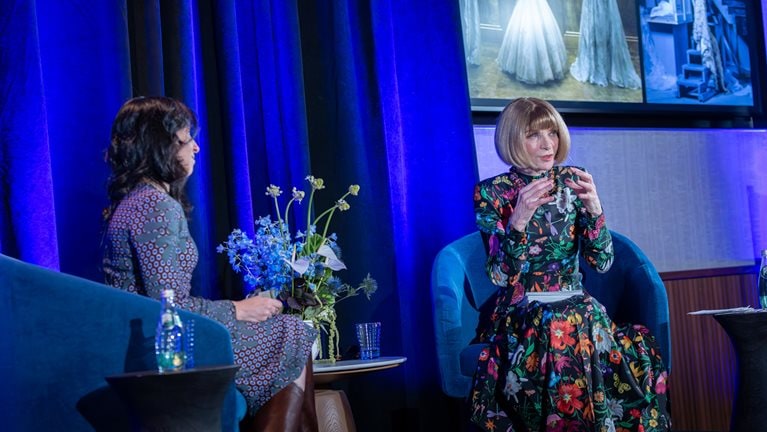
She recalled a 1989 conversation with a conservative businessman on a plane who said he could never imagine such a thing. “So, I went straight back to the office and said, ‘We’re putting Madonna on the cover,’” she says, laughing. The lesson, she added, was not only about trusting instinct, but also about “engaging people you wouldn’t normally talk to—you never know what you might learn.”
Turning moments into institutions
Anna’s creative instincts have done more than sell magazines—they’ve built cultural institutions. Take the Met Gala. When she was first asked to take the helm of the fundraiser in the 1990s, she thought she’d do it for a year.
Instead, she reinvented it as a global phenomenon. “It didn’t happen overnight,” she explained. “It was a great lesson in patience and listening.”
Anna’s stories about later Galas captured both her audacity and her collaborative spirit. She described those moments not as celebrity triumphs but as creative partnerships born of mutual respect and cultural curiosity. “Each exhibition is an adventure,” she says. “And it’s become truly global. Our last livestream was watched by more than 65 million people.”
Inclusion and mentorship as creative engines
For all her reputation as a demanding perfectionist, Anna spoke passionately about inclusion and mentorship. “I like to think of Condé Nast as a place where you can come to learn,” she says. She personally mentors younger talent, adding, “I learn as much from them as they do from me.”
I can’t sew or make anything. I’m useless with my hands. My job is to put creative geniuses together and support them.
Her approach to hiring, she explained, is rooted in humanity. “It doesn’t matter what’s on their résumé or where they went to college,” she says. “I ask myself, am I going to be pleased to see this person when they walk into my office?”
That philosophy has shaped the careers of countless creatives. Naomi Campbell, whom she featured on the cover of Vogue’s landmark September issue in 1989, at a time when representation on fashion covers was still rare, is just one example. She has ushered in a new generation of designers and editors. “Any great designer has a very strong point of view,” she says. “I can’t sew or make anything. I’m useless with my hands. My job is to put creative geniuses together and support them.”
She sees leadership not as solitary vision, but as enabling others to thrive. Her work founding the CFDA/Vogue Fashion Fund after 9/11 and later transforming it into A Common Thread during the COVID-19 pandemic exemplifies that. “When things are difficult,” she says, “being helpful—using your platform to do good for others—is so rewarding.”
Staying grounded in a life of momentum
Anna is famous for her precision and discipline, and she describes her daily rhythm as a grounding force. “I wake up at 4:30, go to the gym, walk through the park, and read,” she says. “But I also believe in balance—leaving at a reasonable hour, spending time with family and friends.” Her weekends in the country, she says, remain sacred. “I need quiet time. I find nature very sustaining.”
Even her reflections on resilience returned to that grounded optimism and focus on hope. During COVID-19, she says, “We had to nurture everyone at Condé Nast, help them find ways to create from home, and keep the spirit alive.” She found solace in helping others and in one simple image: a flower photograph by Irving Penn she chose for Vogue’s cover. “It just says to me hope, and the future, and beauty,” she says. “It’s honestly my favorite cover I’ve ever published.”
The art of leading with curiosity
Anna’s conversation ended where it began—with curiosity. Whether recalling advice from Ralph Lauren (“You don’t want to be too hot, you don’t want to be too cold, but you always want to be there”) or describing how walking through the park fuels her ideas, she emphasized that great editorial leadership starts with engagement—with the world, with people, with culture in motion.
For Anna, instinct, inclusion, and mentorship aren’t just values—they’re disciplines. They’re how she keeps Vogue both timeless and timely. “You have to change and move with the times,” she says, “but you can’t go in the wrong direction. You have to stay true to your own point of view.”
That, perhaps, is Anna Wintour’s most brilliant move of all.


